Optimize Your SEO for Google’s AI: Keys to Appear in AI Overviews in 2026
Introduction
Since the arrival of AI Overviews and Google’s new AI mode (SGE), the way people search for information has radically changed. These AI-generated snapshots provide a synthesized answer from multiple websites directly on the search results page, accompanied by a few cited sources. Traditional SEO alone is no longer enough – you now must adapt your content so that Google’s AI sees it as a trusted source to include in its summaries. In this article, we share strategies to stay visible, boost your organic traffic, and capture prospects’ attention, even in the face of rising zero-click searches (where users get their answer without clicking through). (As of 2024, roughly 60% of global searches ended with no click to any site.)
Google AI Overviews and SGE: What Are They?
AI Overviews: These are AI-generated answer summaries that Google Search produces by compiling information from multiple sites. In just a few sentences, Google provides an immediate answer to the user’s query on the results page, along with citations linking to the source websites. In essence, the AI Overview functions like a rich snippet on steroids, giving users a quick, synthesized response drawn from various sources.
SGE (Search Generative Experience): This is Google’s new conversational search mode, which allows users to continue their search in a dynamic, chat-like manner. After the initial query (which may trigger an AI Overview), the user can ask follow-up questions or clarify their request, and Google will respond in context. The search experience becomes more interactive and dialogue-driven, similar to using a virtual assistant.
A disrupted user journey: With these new features, the user often finds their answer without ever leaving Google. The result is that more searches than ever result in zero clicks to external sites. Your content might be read via the AI’s summary without the user visiting your site, which completely changes the game in terms of traffic acquisition. In short, appearing on page one of Google is no longer a guarantee of getting the click; the real challenge is to be the source that Google’s AI chooses to cite in its overview.
Challenges for Businesses and SMBs
- 📉 Drop in Click-Through Rate (CTR): If Google answers a query directly on its page, even a #1 ranked site can see its visits decline. Far fewer users click the traditional organic results now. In fact, early data shows the click-through rate for the top organic result can plummet by 40–60% when an AI overview is present. This means businesses need to rethink their performance indicators, as high rankings alone may not translate into traffic like they used to.
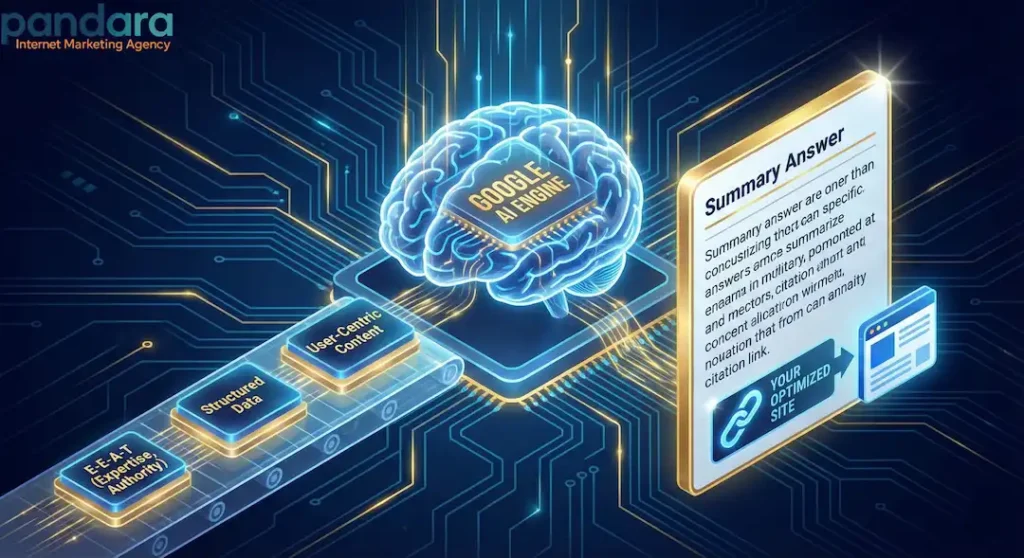
- 🏆 Need for Greater Authority (E-E-A-T): To feed its AI answers, Google favors content with high credibility. The algorithm emphasizes E-E-A-T – Experience, Expertise, Authority, Trustworthiness. It’s crucial to demonstrate your expertise in your field, inspire trust, and provide reliable, up-to-date information. Google’s AI explicitly prioritizes content that shows strong E-E-A-T signals when selecting sources. In practice, this means you must position yourself (and your website) as an authority: highlight the author’s qualifications on your articles, cite reputable sources for facts or data, and consider adding testimonials, case studies, or expert quotes to reinforce trust. The more Google perceives your page as coming from a serious, expert source, the more likely it will be picked up by the AI mode.
- ⚡ Stricter Technical Requirements: The technical side of SEO matters more than ever. A slow or poorly structured site will struggle to be utilized by Google’s AI. Fast load times, mobile-friendliness (responsive design), clean HTML code, and structured data markup, all these elements help Google’s AI understand your pages and also improve the user experience. If your site is clunky or full of technical issues, it won’t be the AI’s top choice. In essence, technical excellence has become a sine qua non for SEO success in the AI era.
💡 Pro tip: A strong SEO strategy starts with solid technical foundations. For example, make sure your website is high-performing and well-designed, perhaps by creating a fast, optimized professional website, before trying to shine in the search results. (It’s hard to get cited by Google’s AI if your site can barely load!)
SEO Best Practices for Google’s AI
To increase your chances of being cited in Google’s AI Overviews, adopt the following best practices now:
Focus on User-Oriented Content (Not Just Algorithms)
Google’s AI favors text that is useful, original, and centered on the user’s intent. Write first and foremost to answer your audience’s questions – not to game the algorithm. In practical terms, this means providing the answer right up front in the introduction of your articles or pages. Get straight to the point about the main query, then expand with clear explanations and supporting details. Illustrate your points with concrete use cases, real examples, and up-to-date data. By delivering high-quality content that brings value to the reader, you also give the AI solid material to potentially quote from your page as a relevant reference.
Strengthen E-E-A-T: Experience, Expertise, Authority, Trustworthiness
Your content needs to inspire confidence in both Google and your readers. As mentioned, Google’s algorithm places heavy weight on E-E-A-T. To reinforce these elements, don’t hesitate to showcase the author’s experience and credentials (especially for specialized topics) and to be transparent about your expertise. Back up any important facts or figures with citations from authoritative sources (studies, white papers, industry reports). You can also incorporate customer testimonials, case studies, or expert opinions to lend credibility to your content. All of these steps bolster your content’s perceived authority and trustworthiness. Remember, Google’s AI is more likely to cite content that it sees as coming from a reliable, expert source, so make sure your page checks those boxes.
Ensure a Clear, Well-Structured Content Layout
A well-structured content layout benefits everyone: readers can find information easily, and the AI can extract key elements more effectively. Use clear headings and subheadings (H1, H2, H3…) that logically reflect the outline of your article. Break up your text into short paragraphs (just a few sentences each) to make it more digestible. When appropriate, include bullet or numbered lists to enumerate important points, and even add FAQ sections if you can anticipate common questions. This kind of thoughtful structuring makes it easier for Google (and its AI) to parse your content. The AI will be better able to identify a precise answer if it’s contained in a well-demarcated paragraph or a clearly labeled question-answer pair. In short, an exemplary content structure increases the odds that the AI can understand and pull your content as a snippet for its overview.
Leverage Structured Data (Schema Markup)
Beyond the visible structure of your text, remember to optimize the “hidden” structure of your pages through structured data markup. Schema markup provides Google with explicit information about your content (for example, whether a page is an article, an FAQ, a how-to tutorial, a product page, etc.). Implement appropriate schema types such as FAQPage, HowTo, Article, Product, etc., depending on the content of your page. These tags not only enhance your chances of appearing in traditional rich results, but also help Google identify your site as a relevant and reliable source for an AI Overview. In other words, by using structured data, you make it easier for the algorithm to understand and present your content. (As an example, adding FAQ schema to a Q&A section could signal to Google’s AI that it can use that format directly in a conversational answer.) Remember: structured data helps Google understand and feature your content in AI responses, so it’s an investment worth making.
Target Long-Tail Keywords and Conversational Queries
User queries are becoming more natural and detailed, especially with voice search and conversational search on the rise. It’s strategic to incorporate long-tail keywords (more specific multi-word phrases) and full question phrases into your content. Think about how your customers might phrase their queries for instance, “how do I…,” “what’s the best way to…,” or “why does…?” and weave these naturally into your titles and paragraphs. Covering these longer, question-like formulations (in a natural way) will help your page align with more precise searches. This in turn improves your chances of ranking for specific queries and directly answering the questions that Google’s AI might get asked. In essence, using a more conversational, Q&A style in parts of your content can make it more likely that Google identifies your page as the ideal answer to surface in an AI overview. (For example, content structured around “How to solve [problem X]” or “What is the best [solution] for [scenario]” aligns well with the kind of intent-driven queries that AI Overviews often address.)
Update Your Content Regularly
Google prioritizes fresh, relevant information. An outdated article is unlikely to be featured by the AI. So, adopt a routine of regular content updates. Refresh your articles with the latest facts, statistics, examples, and references whenever necessary. It can be as simple as adding recent data or replacing a dated example with a current one. Also consider indicating at the top of the article the date it was last updated (e.g., “Updated on Jan 5, 2026”) to signal freshness. Not only does this improve your SEO (updated pages can regain rankings over time), but it also sends a signal that your site is active and trustworthy. In fact, updating old blog posts can significantly boost their organic traffic in the long run, this is one of the tactics we detail in our article “How to Increase Your Blog Traffic with Simple Strategies.” Regularly refreshed content is also much more likely to be used by Google’s AI, which aims to provide the most up-to-date answers to users.
Technical Optimization and UX
The technical fundamentals of SEO remain a must-have for appearing in search results whether classic or AI-generated. Ensure your site is fast, secure, and mobile-friendly. Optimize your images (with proper compression and alt tags), clean up your code, and use reliable hosting to minimize load times. Also pay close attention to user experience (UX): a clear navigation, uncluttered layout, and mobile-responsive design ensure that your content is accessible and pleasant to consume on any device. Fix technical errors like broken links or missing meta tags, and maintain high-quality, semantic HTML code, well-structured code makes it easier for Google’s crawlers and its AI to interpret your pages. In short, remove any obstacle that might prevent Google from easily accessing and understanding your content. A site that’s technically sound and user-friendly lays the groundwork for everything else.
👉 To be visible in AI Overviews, your digital content strategy must be coherent, user-centric, and uncompromising on quality. The best practices above form an interdependent whole implement them together, and you’ll greatly improve your chances of gaining visibility in this new search landscape.
Advanced Strategies to Stand Out
Beyond the fundamentals, here are some advanced strategies that can give your business a competitive edge in the era of AI-assisted search:
Topic Clusters (Content Hubs)
Rather than creating isolated pieces of content, consider grouping your pages and articles into coherent topic clusters. This approach involves defining a central “pillar” topic (for example, local SEO, or content marketing) and surrounding it with multiple related pieces covering specific subtopics. By interlinking these pages (each subtopic page linking to the pillar and vice versa), you strengthen your topical authority in Google’s eyes across the entire subject area. This thematic interlinking helps Google’s AI understand that your site deeply covers a given domain, which can increase your chances of appearing in its synthesized answers on that topic. In essence, you’re signaling that if the query is about X, your site is a go-to authority on X. (This strategy of content hubs is known to help both traditional SEO and AI visibility; when Google’s AI recognizes you as an authority on specific topics, your content becomes a go-to source for multiple related queries.)
Diversify Content Formats
Don’t limit yourself to written blog posts. Diversifying your content formats can benefit both your audience and your SEO. Think videos, infographics, podcasts, and even social media content. Each format allows you to reach prospects in different ways and expand your digital footprint. From Google’s perspective, these varied content types send signals that you offer a rich and engaging range of content. A well-optimized YouTube video or a widely shared infographic can also be picked up indirectly by Google’s ecosystem (for instance, YouTube results or image results) and drive traffic back to your site. At the very least, they increase brand visibility. By varying your formats, you broaden the ways people can discover and interact with your brand online and you give Google’s AI more evidence of your content’s value across different mediums. (Plus, an informative video or a podcast transcript might even be referenced by the AI in certain contexts.)
Adopt an “Answer-First” Content Mindset
Finally, put yourself in an “answer engine” mindset when creating content. This means writing each piece as if it needs to directly answer a specific question your audience is asking. This shift in perspective sometimes referred to as Answer Engine Optimization (AEO) pushes you to be more concise, clear, and relevant. Before you write, ask yourself: “What question is the user really asking here, and how can I answer it as effectively as possible?” Then structure your page to deliver that answer immediately, and use the rest of the content to elaborate on important points or provide supporting info. By adopting this answer-focused approach, you greatly increase the likelihood that Google’s AI will identify your text as providing the solution to a user’s query and therefore highlight it in an AI Overview. (For further exploration, remember that even the fundamentals of local SEO and digital marketing remain crucial for small businesses. We’ve dedicated a full article to [why local SEO and digital marketing are essential, even for well-established small businesses].)
Conclusion
The emergence of Google’s AI Overviews and its conversational mode is transforming the SEO landscape. Now, simply ranking on the first page doesn’t guarantee clicks – the real challenge is to be the source that Google’s AI chooses to quote in its answers. The good news is that by focusing on authority, clarity of content, optimal structure, and a laser-focus on user intent, you can continue to grow your visibility despite these evolutions. In fact, these efforts will not only protect your organic traffic, they can help you capture new audience opportunities thanks to the AI-generated answers. The search game isn’t over; it’s just playing out in new places on the page. By adapting quickly and upholding the highest content quality, you position yourself to thrive in this new era of search.
👉 Discover how our small business SEO services can help you attract more qualified traffic to your site and stay ahead in this new era of online search.
By Pandara Team / pandaramarketing.com